
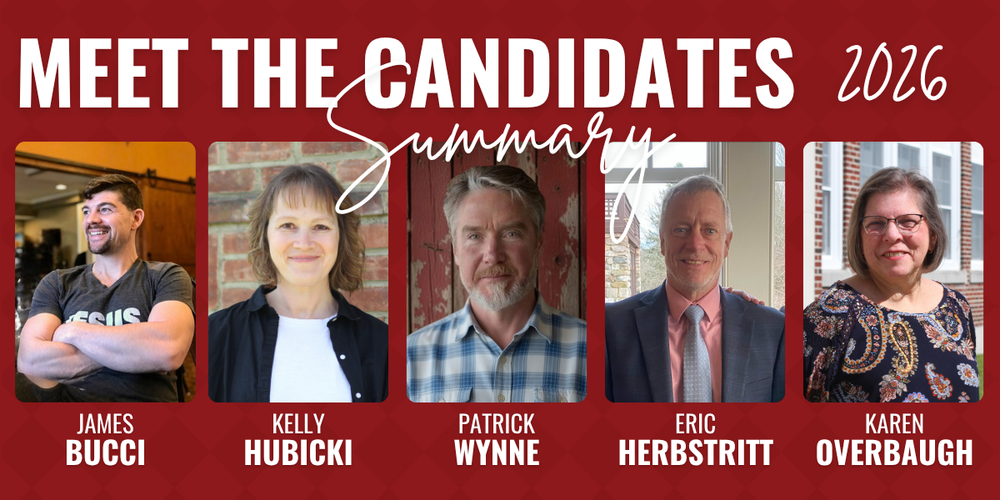
On Tuesday, May 5, 2026, the PTSA hosted its annual Meet the Candidates Night. The event was moderated by the League of Women Voters of Albany County. All questions were submitted by community members and selected by the moderator. Candidates had two minutes to respond to each question. Below is a summary of each candidate's responses.
Candidates rotated going first when responding to questions. For continuity purposes of this summary, candidate responses are listed in the order they were drawn at random, not in the order they spoke.
This summary, produced by the district’s Communications Specialist, is intended to be an impartial overview of statements from the event. Please refer to the recording for the candidate’s full responses, in their own words.
Opening Statements
Patrick Wynne has 30 years of experience working with non-profits and 10 years on school boards and educational committees. He has two daughters at the elementary school and moved to the area a few years ago in search of a rural community to raise his children. He is running for school board because he saw an opportunity to use his skill set to give back to the community.
Eric Herbstritt believes education is an important part of growing up and becoming an adult. He believes no two children are the same, and they need the skills to work and contribute to society, regardless of the career path they choose. He believes that school molds children socially and that students should be encouraged to explore interests outside the classroom. He has served on the school board for six years and believes the board has been fiscally responsible in that time.
James Bucci grew up in the area and started school at Greenville in third grade. He met his wife in high school, graduated from Greenville, raised two daughters who attended Greenville, and has nieces and nephews in the school. He believes he understands the school community and culture. His goal is to serve as a bridge to the community and support the board’s goal of transparency. He has run for the board twice and was appointed in December, which he said has been a great experience. He has enjoyed the superintendent search process and hopes to see it through. He believes his self-employment background would bring a different perspective to the board and help with future capital projects.
Karen Overbaugh’s husband is the former transportation supervisor for the district. They moved to Greenville for the schools 25 years ago. Overbaugh raised four kids who all graduated from Greenville and have done well professionally; her daughter is a music teacher at Greenville. She is proud to be part of the Greenville family, having spent many years as the secretary at Ellis, which she said was like being a grandmother to 500 kids - ensuring they had lunch money, a place to talk, and someone to walk them to the bus. She wants to be your voice on the Board of Education.
Kelly Hubicki moved to Greenville in 2002. Her husband grew up here. She has twins who graduated from Greenville in 2023, and her youngest is in third grade. Since her kids started school in 2010, she has been an active member of the school community, volunteering for anything and everything. In her time on the board, she has worked to improve communication through her Coffee and Chat initiatives and the Board of Education newsletter. She serves on the District Level Team and the technology committee; she is an advocacy representative for the NYS School Board Association; she teaches preschool; and she is a member of the GEF and her local church. She has truly enjoyed her last three years on the Board of Education.
What experience or qualifications matter the most to you in the search for a superintendent? What specific problems or issues will you ask that they prioritize?
Patrick Wynne shared that he has experience working with the school board in the Bronx and evaluating superintendents. He is looking for an instructional leader who is active, engaged, a communicator and collaborator, and who embraces community input. He noted that classroom experience would also be valuable. He has worked through many searches for administrators and principals and believes community engagement is important. He would ask the new superintendent to review the elementary ELA curriculum, focus on literacy, and prioritize how the NY Inspires graduation redesign is rolled out and communicated.
Eric Herbstritt was on the board during the search for Mr. Bennett. He seeks similar characteristics - someone who communicates with the community, is involved with students, understands what is required from education, has a background in building budgets, and knows how to be responsible for the business of a school. Communication between the school and the public, and having the respect of the students are primary qualities.
James Bucci says a good leader needs to listen to different stakeholders in the community to ensure students are being served properly. He says primary stakeholders are teachers and staff. One of his concerns is ensuring clear expectations for all staff and students. He hopes the new superintendent can work well within the board's policies, especially regarding discipline, to ensure teachers have the support they need within their classrooms to teach well. He wants a leader who is adaptable, confident, and can deal with the difficulties coming from the state over the next few years.
Karen Overbaugh believes that selecting a superintendent is one of the Board of Education's most important responsibilities. She seeks someone safety-focused, as it was one of Mr. Bennett’s strongest attributes. She believes the superintendent must be experienced in finance and education law. Experience as a superintendent is a plus, but classroom experience is most important. She truly admired Mr. Bennett’s visibility and hopes the same for the next superintendent. The kids and staff knew who he was and knew his door was always open.
Kelly Hubicki agreed with the other candidate’s answers. She believes the next superintendent should have a vision for the future, especially regarding changes from the state, such as finances and EV buses. She shared that the next superintendent needs to truly understand Greenville and its uniqueness. They should be a listener, a team leader, recognize the value of the people they work with, and give everyone a voice at the table. She also believes an educational background is important so they understand what goes on day-to-day in the classroom.
How would you deal with rampant vaping, marijuana, and alcohol use in the MS/HS bathrooms?
Patrick Wynne believes education is key. He has heard of students who avoid using the bathroom during the day because they fear vaping and don’t want to get involved. He also said kids can’t sit through a period because their addiction to the devices is so strong. Wynne would look to other schools for models that could apply to Greenville. He believes it’s a widespread issue that requires everyone to work together and is not convinced punitive measures are the answer. He supports family engagement and data collection as best practices. However, more information and attention are needed on the issue.
Eric Herbstritt believes that, as a board member, he has been supportive of the employees with this complex problem. He believes the first part to remember is that students' use of these products is illegal - whether it’s tobacco, marijuana, or alcohol. He believes the school needs to provide a safe place for everyone, but parents need to know their kids are doing it and take some responsibility. He also believes education is necessary for students to change their behavior. He does not believe that locking the bathrooms is the solution. He believes the community can help get these problems out of the school system.
James Bucci shared that the board has been asking for more input on this problem, which has gone on too long. He believes a good place to start is knowing the law and policy. He urged for answers to questions like what options principals have to enforce the policy and what recourse exists if students are caught, but paraphernalia isn’t found when a search is conducted. He wants clearer structures or stated consequences when students engage in these behaviors. Whether suspension or detention, consequences need to be clear. He noted the board successfully implemented and enforced the cell phone policy and Covid mask mandate, and the same should be done for vaping and alcohol issues.
Karen Overbaugh believes these are real problems at Greenville. The board has discussed them and asked for updates at every meeting. However, more needs to be done, including the implementation of a formal plan with clear expectations for students and staff. There should be expectations for staff when behavior is discovered and clear consequences for students who make bathrooms unusable by participating in these behaviors. She believes it’s unacceptable that some kids avoid restrooms because of vaping. She agreed vape detectors are a good first step, but said they need to look further and to other schools to develop a plan that fits Greenville.
Kelly Hubicki noted there is a policy and a Code of Conduct with categories for consequences. She believes the next step is to task the Superintendent and administrative team with enforcing the existing policy and consequences. She sees room for improvement and says a procedure like the cell phone policy - where a plan was implemented and followed - needs to be put in place. She also believes more could be done with education and that the district could lean on local lawmakers to crack down on shops selling these products.
How do you think decisions about the library collections should be made? How should parent complaints about book subjects or titles be handled?
Patrick Wynne shared that he is the Director of the Rensselaerville Library and that, if elected, he will recuse himself from all matters related to the library. That being said, this is an important issue to him, and he trusts the staff and administration to make the decisions. He believes there is a clear process. If the book has educational value, is age-appropriate, and meets professional standards, then no one person, parent, or community member should decide what everyone else should have access to in a library. He appreciates the existing committee's openness to hearing concerns and believes the process is fair and reasonable. However, he supports the library staff and the school on this matter.
Eric Herbstritt shared that there is a policy and a procedure in place for this. Parents can opt their children out of content that is not appropriate for them. Parents can guide their children on what they should and should not read. As a parent, Herbstritt chose to have his children read everything they could in the library because it was age-appropriate. He does not believe the district should limit content. If librarians are doing their jobs and the committee is doing its job, then the books on the shelves are appropriate. If there is a recommended reader age marked on the book, then it should be a parent/child decision.
James Bucci says his perspective comes down to respecting the rights of parents and individual children. If the district can do that, it’s succeeding. He does not believe one set of parents should limit what another set wants their child to see. He expressed concerns about the existing rating system, noting that movie ratings are much clearer. He believes the Young Adult content rating system for books is too broad and would like to consider revising it so that parents can better understand book content. He also wants to ensure that if parents opt their children out of certain books, the procedure is enforced and those children do not have access to them.
Karen Overbaugh shared that the district has faced these issues in the past and has had quite extensive discussions about the library collection. She believes it’s not only a school or parent problem. Both groups need to work together to provide students with age-appropriate reading material and encourage them to read as much as possible. She believes there needs to be clear criteria for selecting books, that parents help develop, so it doesn’t just depend on one person making the choices. There are professional standards regarding what’s appropriate for students in certain age groups, and Greenville has a procedure for checking out young adult books. She believes it may come down to enforcement and that all must be informed of the existing policy and procedures.
Kelly Hubicki shared that this was a hot topic when she ran for her seat three years ago. She says there are policies and procedures in place and she supports a very educated staff and administration. She does not believe it is her job as a board member to tell people what to read and not to read. While she has opinions as a parent, she says the library must have something for everyone, and if a book is to be removed, it must be for a very good reason, citing the committee that can review any complaints or concerns. Hubicki believes taking something out of the library is a slippery slope that could lead to more people seeking to remove more books from the library shelves.
Over the last four budgets, GCS has cut teaching positions. Can you explain how cutting teaching positions improves student learning?
Patrick Wynne shared that budget decisions are complex and involve many constraints to consider. He believes the district could adopt a more long-term approach to avoid difficult budgetary decisions. He also supports full transparency about how decisions are made and what options the board is considering for the future.
Eric Herbstritt shared that as a board member, he can’t change the cutting of an individual’s position because that’s the Superintendent’s role - balancing which people are in which classrooms. He believes the next superintendent should understand how to manage that balance. He referenced that this year’s cuts are retirements that are not being filled. He believes it’s a shared responsibility to ensure personnel are reorganized appropriately to best serve the student body.
James Bucci said cutting teachers can’t be helpful. He worries that cutting teachers might become appealing to schools, especially given gains in AI and national trends. He believes teaching staff are the crown jewels of the school. He also noted that the district invests considerable funds in continuing education and professional development, both of which are important investments and reasons not to cut teachers. He hopes downsizing would be non-renewal, not cuts. Unfortunately, he said, this is coming. It must be addressed with a plan created years in advance. He does not want teacher cuts to be something people find out about at budget hearings. He wants the information to be forecast 2-3 years in advance.
Karen Overbaugh agreed that cutting teachers does not improve learning. She is grateful that the cuts for next year were carefully made by the interim superintendent and building leadership. She reiterated that there will be no impact on class sizes, but there will still be an impact. She believes the board must balance respect for taxpayers with giving teachers and students what they need to succeed, which is difficult. She said Greenville needs a long-term, overall fiscal plan.
Kelly Hubicki believes cutting teaching positions will cause problems for students. However, she thinks Greenville has been responsible in recent budgets by not cutting positions that remove teachers from classrooms. She referenced three non-classroom teaching positions being removed this year - roles such as reading and technology coaches. Their work can be redistributed to get the job done. She believes that the last time classroom teachers were cut was 2012, when both her kids lost teachers. She said the board has been responsible in handling downsizing.
What are your ideas for recruiting and retaining quality teachers?
Patrick Wynne believes recruiting starts with school culture and that Greenville should match salary and benefits packages to attract teachers. He also believes teachers need classroom support and resources. The new superintendent should foster a collaborative environment to address concerns. He sees parent engagement as a positive part of the school. It’s a thriving community, and teachers want to be part of a school where the community is engaged.
Eric Herbstritt believes Greenville does a decent job recruiting and retaining quality teachers. He shared that many teachers stay until retirement. He believes the board can support administrators by allowing them to allocate budget funds to properly equip teachers and provide professional development. He noted that if taxpayers want to offer more money to pay teachers, the district could probably hire more, but that would be a tough sell to the community.
James Bucci believes supporting current teachers is key. He appreciates how many teachers attended Greenville with him. He believes culture and financial compensation are major factors and that creating a positive environment where people want to stay, or return, is essential.
Karen Overbaugh believes Greenville does a great job recruiting teachers through college visits, job fairs, and similar efforts. She has worked at Greenville and believes it’s a great place to work - she would recommend it to anyone. She thinks recent improvements to orientation and onboarding are helpful. She says retention is about morale and building a positive culture, and every school can improve. Greenville supports employees well, but could expand professional development for support staff. She shared the idea of “growing our own teachers” through support staff and teaching assistants, by offering time off or financial support for college.
Kelly Hubicki believes administrators do a great job with recruitment. She referenced their work at college fairs and a partnership with Siena. She believes Greenville needs to be competitive with retention. She likes the onboarding process and support for new teachers. She believes there is a strong union. She says the board needs to ask what it can do to be more competitive so new teachers want to stay.
How would you evaluate whether school spending is effective?
Patrick Wynne believes that if the district supports teachers, focuses on the classroom, and provides the right supports for students, success can be measured in different ways. Each student has a different path. The school sets goals, and the budget responds to them. He believes the best way to ensure good outcomes for teachers is to provide support.
Eric Herbstritt believes effectiveness is a broad term. It could be measured by per-pupil spending, college attendance, or a 100% graduation rate. From a budget view, he believes the board is doing well if it provides necessary services without sharply increasing taxes. Costs, including taxes, are rising everywhere. Ultimately, he thinks effectiveness should be judged by graduation rates and the quality of students Greenville produces. He believes money is well spent if students are ready to work and succeed in life.
James Bucci believes effectiveness can be assessed by measuring student performance. However, it is difficult to evaluate because metrics and tests change. He referenced Greenville’s reading proficiency improving this year, but noted the measurement method has changed. Anecdotally, he believes that living in Greenville allows for an assessment of school spending effectiveness through individual experience. He has had positive interactions with graduates but believes effectiveness is hard to measure because metrics change over time.
Karen Overbaugh believes a direct correlation between spending and results is hard to measure. Test scores can be misleading because new programs take years to show results. She thinks some people are quick to discard programs that need more time to work. She believes Greenville should fully utilize existing staff. There are highly qualified teachers and staff who are willing to share their expertise with students, sometimes outside instructional time. She believes in hiring good people and letting them do what they do best.
Kelly Hubicki believes there is no one-size-fits-all answer. What works for one child might not work for another. She believes that if a student shows growth, skills, and preparation from arrival to departure, then spending has been effective. If resources are wasted, spending is ineffective. She says it’s a balance, not a simple answer, and it varies across the district.
How should the Board of Education approach state or government requirements/mandates while still addressing the priorities and concerns of local families?
Patrick Wynne believes that if elected, he would follow mandates and strongly support state advocacy. He said issues like EV buses need strong advocacy at the state level to advance in the budget. He believes it’s a complex issue and the state must better support schools.
Eric Herbstritt says mandates are not optional, and as a board member who has taken an oath, he’s going to follow them. He believes in using individual voices to do something - like lobbying. He urges voters to contact their representatives about topics they are passionate about. He believes that if it comes down to following a mandate or losing 16 million dollars in aid, he won’t ask taxpayers to pick up the tab - he will follow the mandate.
James Bucci believes each board member takes an oath and must work within it while following their conscience. If a mandate seems outside the constitution or conscience, members must hold to their convictions and state them clearly. He referenced the EV bus mandate and said the district still doesn’t know the exact consequences of noncompliance. His main concern is decisions made under pressure. He recommends the board review all mandate wording carefully before acting. He wants full understanding and is willing to go to the Governor or people for a vote to decide what’s best for students. He believes people can speak up and hopes they do.
Karen Overbaugh believes board members are obligated by oath to uphold state and federal laws. She would not recommend refusing to follow a mandate. However, she believes voters can contact elected representatives in Albany or Washington to effect change. Schools can’t avoid mandates but can influence them through political pressure, board statements, and community voices. She believes lobbying is the best way to approach mandates.
Kelly Hubicki shared that she has spent two years lobbying. She specifically spoke to her experience lobbying against the EV bus mandate. She shared that she asked what would happen if the district did not follow the mandate and was told the district would lose its transportation aid. She believes the more voices that come together, the louder the collective voice. More pressure on the state increases the chance of change. She believes defying a mandate at this level would only hurt the kids. She sees a mandate as a responsibility, but also believes in speaking up to make change without harming students.
Closing Statements
Patrick Wynne shared that he has two daughters at Ellis and has had an exceptional experience with the teachers. He also has two older daughters who grew up in the Bronx, where he was very involved in their PTA and school leadership. Eventually, he joined the school board, and that was his intention here - start slow, and gradually get more involved. But an opportunity arose now. He shared that he has extensive experience in budgeting, facility management, supervising superintendents, and hiring administrators. He has 30 years of experience working with nonprofits and over 10 years on school boards and educational committees.
Eric Herbstritt has served on the board for the past six years and hopes to continue to serve for the next three. He believes they have been fiscally responsible with past budgets and projects, and he will be the same if elected again. He says he won’t change, he will continue to be him - no surprises. He hopes to continue the search for a superintendent. He thanks the voters for their trust and support and, most importantly, asks them to come out and vote.
James Bucci shared that his goals, if elected, include seeing the superintendent search through to completion and being a bridge for all community stakeholders. He hopes people see him as approachable. Whether they agree with him or not, he wants them to know he will listen and understand. Bucci seeks to foster good conversation and provide a different perspective to the board. He appreciates seeing different personalities and perspectives on a school board and believes that leads to the best results.
Karen Overbaugh has been attending board meetings for 25 years, since her husband was the transportation supervisor. A board meeting and ice cream - that was date night. If elected, she promises to bring him out for ice cream! Overbaugh brings a wealth of institutional knowledge to the board. She has worked at Greenville for 20 years - she believes she has learned a thing or two in that time and brings a new perspective to the board because of that. She is not the kind of person who says “that’s the way we’ve always done it,” she encourages people to look at the why and figure out if it’s right. She wants to listen to taxpayers, teachers, parents, and staff. She is ready to help guide people through situations and point them in the right direction. She believes in a chain of command to approach difficulties. She might not be able to fix it all, but she can point you in the right direction. She is proud of the work she has started and would like to be elected to finish out the process.
Kelly Hubicki has appreciated getting to know students, families, employees, and processes in her time on the board. She believes Greenville is an amazing district with a lot to be proud of, but it is facing many changes, including the search for a new superintendent, new graduation requirements, EV bus mandates, and fiscal questions. The district has to tackle those changes, and her history and experience make her uniquely suited to do so. She will ask the hard questions and is not afraid to change her mind if someone can show her that a different way is better. She appreciates the opportunity to go to Albany and advocate for Greenville schools and hopes to continue doing so if reelected.